
Green Olives vs Black Olives: What Is the Difference?
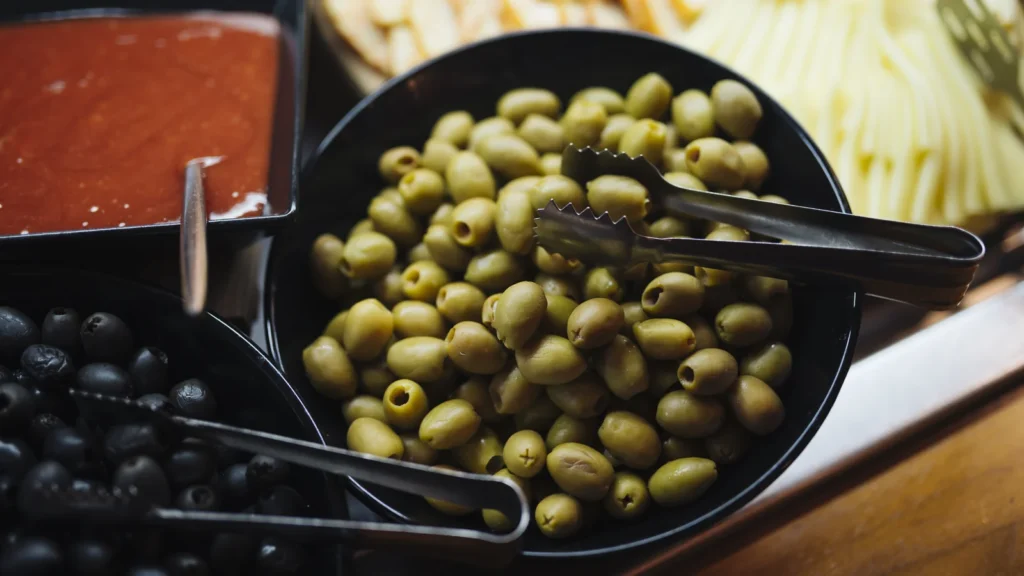

Green olives and black olives grow on the same trees. The difference starts with when they are picked: green olives are harvested before they ripen, black olives when they are ripe or nearly ripe. After that, the curing method shapes the final colour, taste and texture just as much. Here is what the International Olive Council (IOC) says about each stage, and what it means in the kitchen.
It starts with ripeness
Olives change colour as they ripen, from leaf green to yellowish green, then to pink, violet and finally black. The IOC describes three harvest stages for table olives:
| Stage | When it is picked | Typical result |
|---|---|---|
| Green olives | At full size, before any colour change, while the fruit is firm | Firm, crisp, often tangy and slightly bitter |
| Olives turning colour | When the colour begins to change, before full ripeness | Pink to brown-violet, firm |
| Black olives | Close to full ripeness, with the colour and oil content typical of the variety | Softer, fruitier, richer |
Raw olives are very bitter because of a compound called oleuropein, so almost all olives need curing before they can be eaten. That is true of green and black olives alike; see are olives a fruit? for more on the fruit itself.
How curing changes the olive
Curing removes bitterness and preserves the fruit, and the method can matter as much as the colour.
- Spanish or Sevillian-style green olives: treated with a dilute lye solution, then fermented in brine. The IOC describes a fermentation at around 5% salt, which gives these olives their tangy flavour.
- Greek-style black olives in brine: ripe olives fermented in an 8–10% salt brine, which slowly removes the bitterness. The IOC notes that Greece commonly uses the Conservolea variety this way, that the olives may be packed with a little vinegar and a layer of oil, and that Kalamata olives are prepared similarly and are often slit.
- Dry-salted black olives: overripe olives layered with dry salt until they wrinkle like raisins; the IOC describes this as a Greek method using the Megaritiki variety.
- California-style “black” olives: picked while still green or turning colour, then treated with lye and darkened by exposure to air (oxidation). That is why canned ripe olives are uniformly black and mild.
So a black olive is not always a ripe olive, and colour alone tells you little about flavour. The label is the best guide: look for the variety, the words “naturally ripe” or “in brine”, and any ferrous gluconate (an additive used to fix the black colour of oxidised olives).
Taste and texture compared
| Green olives | Black olives (naturally ripened) | |
|---|---|---|
| Texture | Firm, crunchy | Softer, meatier |
| Flavour | Sharp, grassy, sometimes bitter | Rounder, fruitier, often winey |
| Common examples | Halkidiki (Chalkidiki) and many Spanish-style olives | Kalamata, Conservolea, dry-salted throuba |
| Good for | Martini-style snacks, stuffing, bright salads | Salads, stews, tapenade, baking |
Kalamata olives sit in between: they are harvested ripe, so they are deep purple to brown-black rather than jet black, and they keep a firm bite. Our guide to Kalamata vs black olives covers that comparison in detail, and Greek olive types introduces the main Greek varieties.
How do they compare nutritionally?
Both are mostly water and fat, and both are cured in salt, so they are salty foods. Exact values vary with the variety and the brine, so compare the nutrition labels of the jars you have. For figures on Kalamatas, see our Kalamata olives nutrition page.
Using them in the kitchen
Choose by job rather than colour. Firm green olives hold their shape in marinated olives and stuffed snacks. Fruity black or Kalamata olives suit a Greek salad, dakos and olive tapenade. The liquid in the jar is useful too: see olive brine for ideas.
Explore our Kalamata olives and the Kalamata olive collection.
Sources
Green vs black olives: frequently asked questions
Do green and black olives come from the same tree?
Yes. Green olives are picked before they ripen and black olives when they are ripe or nearly ripe, so one tree can give both.
Why are canned black olives so uniformly black?
Many are California-style olives: picked before full ripeness, treated with lye and darkened by exposure to air. Naturally ripened black olives vary more in colour.
Are Kalamata olives black olives?
They are harvested ripe and are dark purple to brown-black, so they are usually grouped with black olives, but they are a specific Greek variety.
Which tastes better, green or black?
It is a matter of taste. Green olives are firmer and sharper; ripe black olives are softer and fruitier.

Good things from our land, ideas for your table.
Explore the pantry journal →