
Sea Salt Flakes vs Ground Sea Salt: Choose the Texture for the Dish
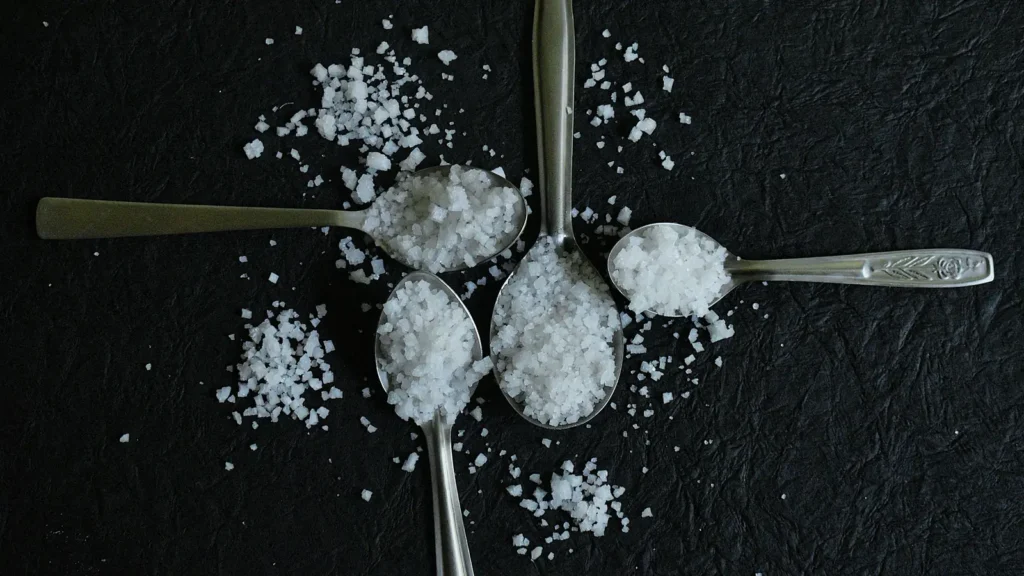
Choose sea salt flakes for a finishing texture and ground sea salt for seasoning distributed through a dish. Both can be used in cooking; the difference you notice depends on whether crystals remain on the food or dissolve. For a final sprinkle over tomatoes or vegetables, try flakes. For a dressing or sauce, consider how evenly the salt mixes through.
Also in this guide: Reading a Greek Sea Salt Label: Harvest Origin, Packing and Product Form · A Sea Salt Cellar on the Counter: A Dry, Clear Kitchen Setup · Sea Salt for a Salt Grinder: Check the Mechanism Before Refilling · Sea Salt in Baking Recipes: Read the Ingredient and Topping Instructions Separately · Sea Salt in Pasta Water: Coordinate the Pot, Sauce and Final Seasoning · Sea Salt in Salad Dressing: Dissolve First or Finish the Plate? · Weighing Sea Salt for Recipes: A Practical Measurement Workflow
Do not replace one salt with an equal spoonful by default. Crystal shape and size affect how salt fills a spoon. Follow the recipe’s specified salt and measurement; when a weight is provided, use that rather than a guessed volume conversion.
Flakes and ground salt at a glance
| Kitchen question | Sea salt flakes | Ground sea salt |
|---|---|---|
| What does the description mean? | A crystal form; the actual shape varies by product. | Salt crushed to smaller particles; the fineness varies by product. |
| When is the form noticeable? | A final sprinkle can leave distinct crystals on the surface. | Smaller particles can make scattered seasoning convenient. |
| What happens in a wet mixture? | If fully dissolved, the original crunch no longer remains. | If fully dissolved, the original grain texture no longer remains. |
| Can I swap teaspoon for teaspoon? | Avoid a universal conversion; shape affects packing. | Avoid a universal conversion; size affects packing. |
| Does the name establish fleur de sel or origin? | No. Read the product’s own details. | No. Read the product’s own details. |
Shape and size answer different questions
Flakes describe a crystal form. Maldon, for example, identifies its salt as pyramid flakes and describes a delicate crunch. That is a first-party description of its own product, not a promise that every flake salt has identical crystals.
Ground describes a size-reduction step. Le Guérandais explains ground sea salt as coarse salt that has been crushed. A ground salt can still differ in fineness, so check the pack rather than assuming the word ground always means a very fine powder.
You are therefore comparing both form and particle size. Looking at the actual salt helps you understand what the words mean on that package.
When flakes make a difference
Try flakes where the salt will sit on the surface near serving time. A small pinch over tomato slices, a cooked vegetable or a simple piece of bread lets you notice the placement and texture. Begin on part of the portion and taste before seasoning the rest.
Maldon’s directions include pinching and sprinkling its flakes for finishing, as well as using them during cooking. Finishing is a useful way to explore the crystals, but it is not the only permitted use.
If you crush flakes between your fingers, you change the pieces reaching the food. That can help distribute a lighter sprinkle, though it also changes the texture you started with. Decide whether you want distinct crystals or a more scattered seasoning.
When ground salt is convenient
Ground salt is practical when you want seasoning dispersed through food rather than a few prominent crystals on top. The relevant question is whether you can distribute and measure it consistently for the preparation.
In a dressing, sauce or another wet mixture, give the salt time to dissolve and taste again before adding more. A visible grain that disappears changes the eating experience. Once the crystals are dissolved, their original crunch is no longer part of the dish.
This does not make flakes unsuitable for cooking or ground salt unsuitable for finishing. It simply helps you decide which feature you will actually notice.
A spoonful is not a universal conversion
Crystal shape affects how salt packs into a spoon. SaltWorks explains that its flake salts have lower bulk density and are lighter by volume than traditional sea salts. That is why a volume measure can change when you swap salt forms.
Do not invent a fixed conversion such as one teaspoon of every flaky salt equals a particular fraction of a teaspoon of every ground salt. Brands and crystal sizes vary, and crushing the flakes changes how they fill the spoon.
For a recipe, keep the specified salt and measuring method where practical. If the recipe supplies a weight, use a suitable kitchen scale rather than replacing it with a guessed spoonful. For informal finishing, start modestly and taste.
Treat baking and other carefully measured preparations differently from an adjustable final sprinkle. Following a recipe’s ingredient specification makes the result easier to reproduce.
Keep the comparison fair
If you want to explore the difference at the table, use the same food in two portions. Put a small amount of one salt on one portion and the other salt on the second. Note the texture and how evenly the salt is spread, rather than trying to award a universal quality score.
Do not use equal heaped spoonfuls and conclude that one salt is inherently stronger. You may simply have changed the amount of salt. A small, careful comparison is more useful than a large sprinkle that overwhelms the food.
This is a suggested preference exercise, not a published Greek Bounty kitchen test. Your observation applies to the salts and serving you actually compare.
Flakes are not automatically fleur de sel
A flaky appearance does not establish a surface-harvested fleur de sel identity. Fleur de sel describes a harvest as well as a product; the name should come from the product’s own details. Similarly, a Greek origin claim does not tell you whether the salt is flaked, ground or another form.
Our fleur de sel guide explains that surface-harvested salt and the Greek example Afrina. Use it alongside this shape comparison when checking a label, rather than treating fleur de sel, flaked and ground as interchangeable words.
Choose what you will use
Check the exact salt name, grain or flake description, ingredients and storage guidance. Keep it dry during serving and use an appropriate clean utensil. Choose a container or dispensing method that suits the form you have.
Explore the Greek sea salt collection and read the details supplied for each product. Flakes are an interesting choice when final texture matters; ground salt is convenient when controlled distribution matters. Neither description, by itself, establishes certification or the complete quality of a salt.
Reading a Greek Sea Salt Label: Harvest Origin, Packing and Product Form
A Greek sea salt label can tell you several different things: where the salt was harvested, where it was packed, which business sells it and what form is in the pack. Read those details separately. A Greek brand or packing address does not, on its own, answer the harvest-origin question.
Look for a named harvest location
Start with any explicit statement about where the salt was collected. A named saltworks or lagoon gives you a more precise question to investigate than a landscape photograph on the pack. Hellenic Saltworks’ account of Afrina, for example, connects that product with Messolonghi and describes its surface collection. That is evidence about the product described by that producer.
Separate harvesting from packing
Read the wording around each place name. “Harvested in,” “packed in” and a business’s contact address describe different activities. If the pack leaves the harvest location unclear, ask the seller for that specific detail. A short, precise origin question is easier to answer than a general request for authenticity.
Check the salt form
Fine salt, coarse crystals and a delicate finishing salt can come from the same broad category but serve different kitchen roles. The flakes and ground sea salt comparison explains texture, while our Afrina and fleur de sel guide covers a particular finishing-salt description.
Keep the product details together
When comparing packs, note the named producer, stated harvest location, crystal form, ingredients and pack size. That gives you a useful like-for-like comparison without relying on front-label imagery alone. Explore the Greek sea salt collection for the category and ask about an individual product when you need more detail.
A Sea Salt Cellar on the Counter: A Dry, Clear Kitchen Setup
A useful salt cellar keeps the salt easy to reach while protecting it from kitchen splashes and steam. Choose a dry, food-suitable container, a place away from the hob’s steam path and a small dry spoon if you prefer measuring to pinching.
Choose a dry position
A spot beside the preparation board can be convenient without placing the cellar directly beside a boiling pot or sink. Morton’s storage guidance recommends cool, dry storage and explains that an airtight container can help where cooking moisture is hard to avoid. Follow any additional directions for the actual salt you use.
Match the opening to the job
A wide opening gives easy access for a spoon or a pinch. A lid is useful when the cellar sits out between cooking sessions. Check that the lid can be opened comfortably with one hand and put back without getting in the way of food preparation. A small container also lets you keep the main pack stored separately.
Keep coarse and finishing salts distinct
If you keep two salts on the counter, use distinguishable containers or simple labels. A measured ingredient salt and a delicate finishing salt have different jobs. Our flakes versus ground sea salt guide helps explain that choice.
Refill after cleaning and drying
Clean the container according to its material and let it dry fully before refilling. Use a dry utensil and avoid holding the open cellar over steam. Check it as part of your kitchen routine rather than repeatedly topping up a damp container. Read about fleur de sel if you want a separate finishing-salt dish, or explore the Greek sea salt collection.
Sea Salt for a Salt Grinder: Check the Mechanism Before Refilling
Choose salt for a grinder by checking the mill’s instructions first. Crystal size and moisture matter: a salt that is pleasant as a finishing salt may still be unsuitable for a particular grinding mechanism. “Coarse sea salt” alone is not a compatibility specification.
Dry and damp salt need different consideration
Peugeot’s guidance distinguishes its ordinary salt mechanism for dry coarse salt from a separate mechanism designed for damp salt. It warns that damp sea salt can corrode an unsuitable mill. Use the instructions for your own model rather than transferring another manufacturer’s specification.
Check the permitted crystal size
Look for the size range in the manual or product page, then compare it with the salt specification. Very large crystals may not feed as intended, while fine salt may not need grinding at all. For a quick texture comparison, read flakes versus ground sea salt.
Refill a clean, dry mill
Follow the maker’s cleaning and drying procedure before refilling. Keep the filling opening away from a steaming pan. Avoid mixing an unknown old refill with a different salt: an empty mill makes it easier to know what is inside and to check how the new refill feeds.
Use a cellar when grinding adds little
Delicate finishing crystals can be served from a small dish instead of being forced through a mill. Our fleur de sel guide explains one finishing-salt format. Explore the Greek sea salt collection, then match a particular salt to the equipment and role you actually have.
Sea Salt in Baking Recipes: Read the Ingredient and Topping Instructions Separately
In baking, distinguish salt mixed into dough or batter from salt sprinkled on top. The first seasons the mixture; the second can create a visible, textured finish. Prepare each amount separately and use the form named in your recipe.
Read the unit and the named salt
If the recipe gives grams, use a suitable scale. If it uses a spoon measure and specifies a brand or type, keep that information when choosing the ingredient. Crystal forms do not fill a spoon in the same way. Our flakes versus ground sea salt guide explains why appearance and structure matter.
Distribute salt through the mixture
Follow the recipe’s order for adding salt to dry or wet ingredients. Fine grains are convenient where the aim is even distribution rather than a few obvious crystals. Morton’s salt selection guide distinguishes uses for different salt products; it supports checking form as well as the word salt.
Keep topping salt in a separate bowl
A bread or biscuit recipe may specify a surface finish in addition to the amount in the mixture. Measure these separately so the topping is not accidentally mixed into the dough or added twice. Look for instructions about when the topping is added and whether the surface is brushed first.
Use texture where it will be noticed
A finishing crystal can remain visible on a baked surface. Read the fleur de sel guide when exploring that role, then choose a complete recipe that calls for it. Browse the Greek sea salt collection. A new salt is easiest to assess when the rest of a familiar recipe stays consistent.
Sea Salt in Pasta Water: Coordinate the Pot, Sauce and Final Seasoning
When adding sea salt to pasta water, consider the water, the sauce and the finish together. A sauce containing olives, cheese or other salty ingredients changes the seasoning decision. Use the pasta and sauce recipe as your starting point rather than applying one spoon measure to every pot.
Know the water quantity
A salt amount means little without the amount of water it seasons. If following a recipe with a specified water quantity, measure that as well. Changing to a much smaller pot while keeping the same salt addition changes the concentration. Barilla’s pasta-water guidance gives its own linked water-and-salt recommendation rather than a quantity without context.
Add it at a clear point in the method
Barilla recommends adding salt just before the pasta. Follow the chosen method and stir as appropriate so crystals do not remain as a pile at the bottom. Check the pack’s cooking instructions and keep attention on the pasta’s texture.
Remember the reserved cooking water
If the sauce method uses pasta water, that addition also carries seasoning into the sauce. Reserve water as directed, then add it gradually according to the recipe. Taste the combined pasta and sauce before adding a final sprinkle of salt or cheese.
Choose the salt for cooking, not decoration
Dissolved salt will not retain the surface texture of a finishing crystal. Compare flakes and ground sea salt when choosing a convenient cooking form, and keep fleur de sel for a role where its texture is wanted. Explore the Greek sea salt collection for the broader ingredient category.
Sea Salt in Salad Dressing: Dissolve First or Finish the Plate?
For salt distributed through a vinaigrette, start with the watery or acidic ingredients before whisking in oil. For visible crystals and occasional crunch, reserve a little finishing salt for the plated salad. Those are different effects, so decide which you want before adding both.
Fine salt is convenient in the dressing
Small grains are easier to work into a small liquid portion. Morton describes its fine sea salt as suitable for blending and cooking. Keep the quantities in your dressing recipe, and check the named salt rather than treating different crystal forms as equal spoonfuls.
Mix the liquid ingredients first
For a recipe based on vinegar or lemon juice, combine the specified salt with that liquid and stir before adding oil. Check that the grains are dispersed as intended. Add the oil using the recipe’s method. This keeps the salt step visible instead of losing it among several additions at once.
Taste with the salad ingredients
A spoonful of dressing on its own is only part of the picture. Taste it with the actual leaves or vegetables and any olives or cheese. Those ingredients may already add saltiness. Adjust a small portion before dressing the whole bowl.
Keep finishing crystals for the surface
If the point is a contrasting crystal on tomato or another finished ingredient, add it at serving rather than dissolving it into the dressing. Read fleur de sel and Afrina for that texture, and flakes versus ground sea salt for choosing the form. Browse the Greek sea salt collection for the ingredient category.
Weighing Sea Salt for Recipes: A Practical Measurement Workflow
Weigh sea salt when a recipe gives the quantity in grams and your scale can measure that amount reliably. Weighing avoids the uncertainty of how different crystals fill a spoon. When the recipe uses teaspoons, check the named salt before assuming another product will give the same amount.
Why spoon measures can differ
Flakes, coarse crystals and fine grains pack differently. A spoonful of one salt should not automatically replace a spoonful of another. Morton’s conversion chart illustrates the issue using its named products; it is not a conversion chart for every sea salt. See flakes versus ground sea salt for their different textures.
Check the scale before adding salt
Read the scale’s display increment and operating instructions. A scale that changes only in relatively large steps is a poor match for a tiny salt quantity. Use equipment appropriate to the amount rather than treating every displayed digit as equally meaningful.
Zero the empty vessel
Place a dry bowl on the scale and tare it as the manufacturer directs. Add salt gradually, slowing as you approach the required mass. Measure it separately before tipping it into the mixture; that makes an accidental excess easier to correct.
Separate the mix from the finish
A recipe may contain one amount mixed through the dish and another optional amount on top. Keep these separate while preparing ingredients. Textured finishing salts such as fleur de sel have a different role from salt dissolved or distributed through a mixture.
Keep the useful details
For a recipe you repeat, note the exact salt, the unit and the amount. When changing a product, keep the recipe’s mass measurement where provided instead of introducing a chain of spoon conversions. Explore the Greek sea salt collection for the category.
Choosing a finishing salt? Compare fleur de sel vs Maldon salt.
Sea salt: frequently asked questions
How do I read a Greek sea salt label?
A Greek sea salt label can tell you several different things: where the salt was harvested, where it was packed, which business sells it and what form is in the pack. Read those details separately. A Greek brand or packing address does not, on its own, answer the harvest-origin question.
How do I keep sea salt dry in a salt cellar?
A useful salt cellar keeps the salt easy to reach while protecting it from kitchen splashes and steam. Choose a dry, food-suitable container, a place away from the hob’s steam path and a small dry spoon if you prefer measuring to pinching.
Which sea salt works in a salt grinder?
Choose salt for a grinder by checking the mill’s instructions first. Crystal size and moisture matter: a salt that is pleasant as a finishing salt may still be unsuitable for a particular grinding mechanism. “Coarse sea salt” alone is not a compatibility specification.
How do I use sea salt in baking?
In baking, distinguish salt mixed into dough or batter from salt sprinkled on top. The first seasons the mixture; the second can create a visible, textured finish. Prepare each amount separately and use the form named in your recipe.
How much sea salt goes in pasta water?
When adding sea salt to pasta water, consider the water, the sauce and the finish together. A sauce containing olives, cheese or other salty ingredients changes the seasoning decision. Use the pasta and sauce recipe as your starting point rather than applying one spoon measure to every pot.
Should I dissolve sea salt in salad dressing or sprinkle it on top?
For salt distributed through a vinaigrette, start with the watery or acidic ingredients before whisking in oil. For visible crystals and occasional crunch, reserve a little finishing salt for the plated salad. Those are different effects, so decide which you want before adding both.
Why weigh sea salt for recipes?
Weigh sea salt when a recipe gives the quantity in grams and your scale can measure that amount reliably. Weighing avoids the uncertainty of how different crystals fill a spoon. When the recipe uses teaspoons, check the named salt before assuming another product will give the same amount.
Sources
Maldon: sea salt flakes and directions
SaltWorks: crystal sizes and flake bulk density
Le Guérandais: coarse, ground and flower salt
Continue exploring this ingredient
Browse the sea salt guide library, then explore Sea Salt in Baking Recipes: Read the Ingredient and Topping Instructions Separately and Weighing Sea Salt for Recipes: A Practical Measurement Workflow.

Good things from our land, ideas for your table.
Explore the pantry journal →