
What Is Fleur de Sel? Sea Salt, Texture and Greek Afrina
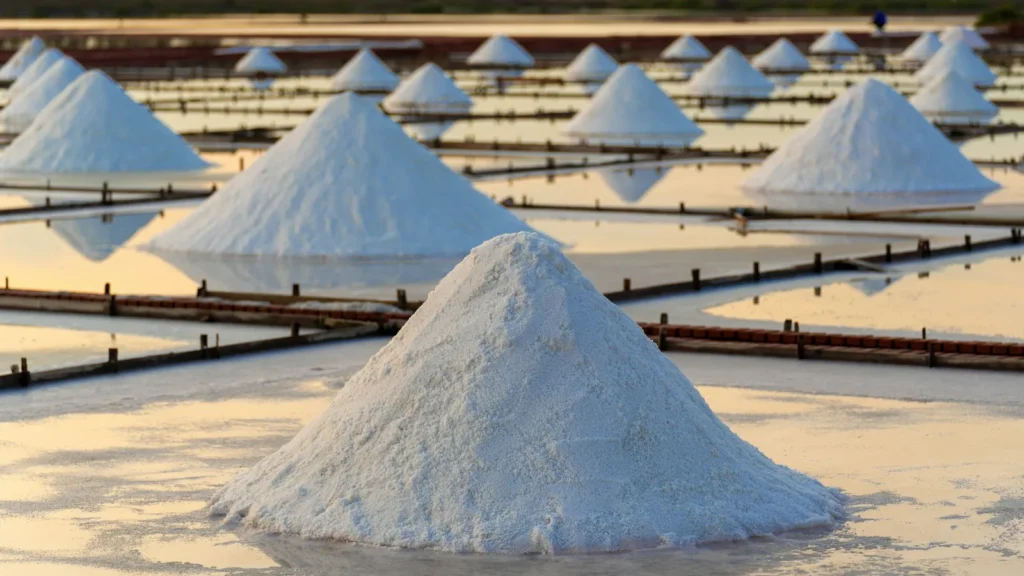
Fleur de sel is a sea salt collected from crystals that form at the surface of concentrated saltwater. Its name means “flower of salt.” In the kitchen, it is especially useful as a finishing salt: a little added near serving time, when you can notice the crystals on the food.
The key distinction is how the salt forms and is harvested. Fleur de sel is a kind of sea salt, but “sea salt” alone does not tell you that a product is fleur de sel. Greek Afrina provides a helpful example of a named surface salt without making every Greek sea salt the same thing.
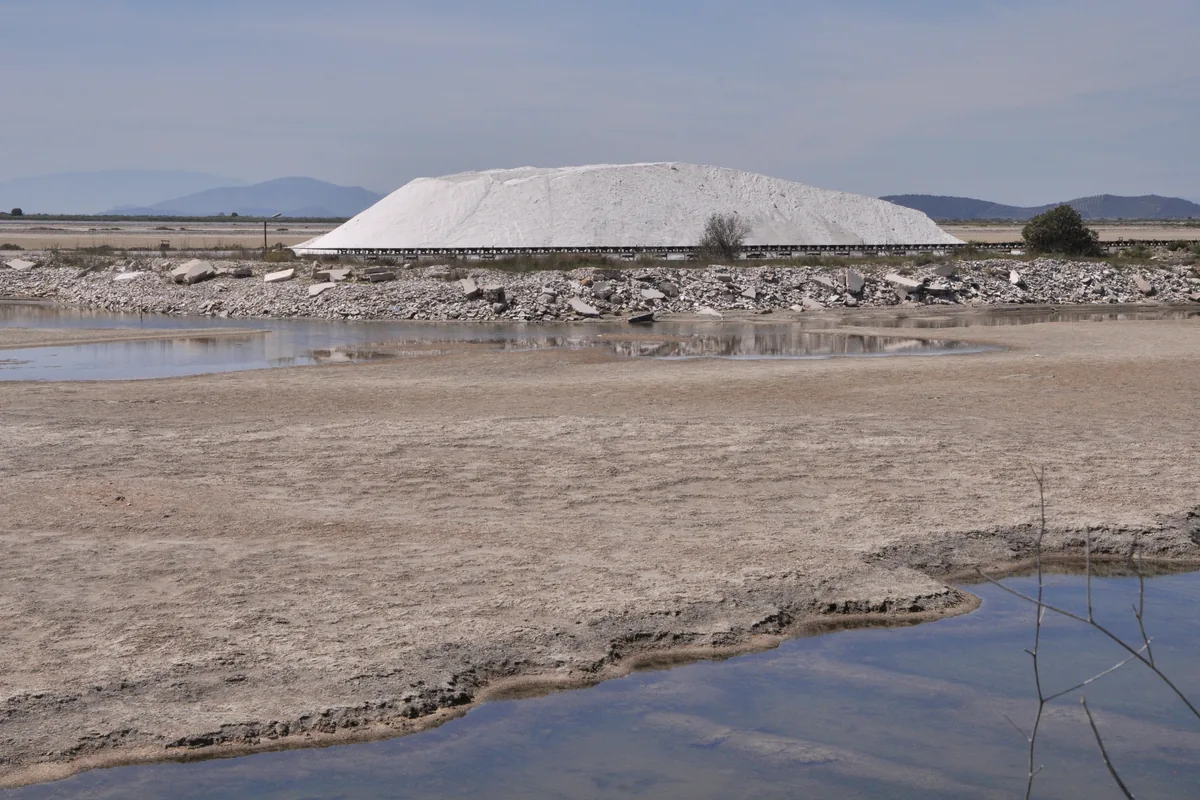
How fleur de sel forms
As seawater evaporates in salt pans, the remaining water becomes more concentrated. Under suitable conditions, a delicate layer of salt crystals can appear at the surface. Those crystals are collected separately from salt that forms lower in the pan.
France’s INAO, the national body responsible for origin and quality designations, explains this distinction for Guérande: ordinary salt crystallizes at the bottom, while fleur de sel forms and is harvested at the surface. The Le Guérandais cooperative describes the careful hand collection of its fragile surface layer.
Weather, location and the salt workers’ method shape the harvest. A description of one saltworks is not a universal timetable for all producers. You do not need to memorize a particular wind direction to understand the useful point: surface harvesting preserves a different crystal structure from salt intended mainly to dissolve during cooking.
Fleur de sel vs sea salt
“Sea salt” is the broad category. It can describe products with different crystal sizes and processing methods. “Fleur de sel” adds information about the surface harvest. Fine sea salt, coarse sea salt and fleur de sel therefore answer different questions about what is in the package.
Fine salt can be convenient when you want seasoning distributed throughout a dish. Coarse crystals may suit a grinder or another use identified on the pack. Fleur de sel is worth exploring when the final grain and small bursts of saltiness are part of the eating experience.
Do not judge these salts only by whether their names sound more luxurious. Ask what you need the salt to do. If it will dissolve completely in a large pot, the finishing texture will not remain there for you to notice. If it sits on a finished slice of tomato, texture becomes part of the reason for choosing it.
Where Greek Afrina fits
Hellenic Saltworks describes Afrina as the local name for flower of salt at Messolonghi. Its account explains that a thin surface crust forms, wind moves it toward the sides of the salt pans, and specialized workers collect it by hand using wooden tools.
The manufacturer’s specification dated February 29, 2024 also lists “Afrina (Fleur de sel)” as a distinct product from its washed sea salt. These are useful first-party descriptions of that producer’s salt and method. They do not establish the identity of another company’s product.
When exploring our Greek sea salt collection, read the actual product designation. A package labeled Greek sea salt should not automatically be described as Afrina or fleur de sel. Origin, crystal size and harvest method should come from that product’s own details.
Use it where you can notice the crystals
Start with a finished food that has few competing flavors. Tomato slices, a cooked potato or a piece of bread with olive oil make simple settings for a small pinch. Season only part of the portion, taste it, and compare it with the unseasoned part.
If the food was already seasoned during cooking, taste before adding anything. The aim is a final accent, not a second full round of salt. Distribute a small amount over the surface so that you do not leave one bite heavily seasoned and the rest untouched.
You can also explore a light sprinkle on chocolate or caramel desserts if you enjoy the combination. Treat that as an optional serving idea rather than a rule. Begin on a small piece; delicate food and strongly flavored food may call for very different amounts.
For an olive-oil-and-bread comparison, keep the bread and salt constant while changing the oil, or keep the oil constant while changing the salt. Changing everything at once makes it harder to learn what you prefer. Our olive oil selection guide is a useful companion if you are comparing oils too.
Can you replace another salt with it?
Often you can season the same food with either salt, but the result may differ in texture and distribution. A spoonful of one crystal shape is not automatically equivalent to a spoonful of another. In an established recipe, follow its specified salt and measurement method where practical.
For informal finishing, start with less than you think you need and taste. If your only salt is fleur de sel, there is no requirement to reserve it for special occasions. Just recognize that dissolving it into a sauce gives up the surface texture that makes it interesting.
Likewise, a pinch of another food-grade sea salt can still season a tomato well. The point of fleur de sel is the particular experience of the crystals, rather than a claim that ordinary salt cannot do the job.
A label and texture checklist
Look for the exact product name, declared origin, harvest description if supplied, ingredient information and storage directions. Check whether the pack identifies fleur de sel or only sea salt. Any protected-origin claim belongs to the named product and cannot be transferred to another salt with similar-looking crystals.
At home, use a clean, dry spoon and close the container after use. Follow its storage instructions, and keep it away from cooking splashes. Handling it gently helps preserve the crystals you chose it for; grinding it changes the texture.
A small finishing choice with a clear purpose
What is fleur de sel best understood as? A surface-harvested sea salt whose crystals can add interest at the end of preparation. Choose it when you want to notice that final texture, and choose your everyday cooking salt according to the dish and its instructions.
Afrina adds a Greek chapter to that story. Understanding the name gives you a better question to ask about a package, while the label tells you which salt you actually have.
Sources
INAO: Guérande salt and fleur de sel
Le Guérandais: understanding fleur de sel
Hellenic Saltworks: Afrina history and harvest
Hellenic Saltworks: salt specifications (February 2024)
Continue exploring this ingredient
Browse the sea salt guide library, then explore Sea Salt for a Salt Grinder: Check the Mechanism Before Refilling and Sea Salt in Salad Dressing: Dissolve First or Finish the Plate?.

Good things from our land, ideas for your table.
Explore the pantry journal →