
Sesame Seeds Nutrition Facts (USDA Data for Whole, Hulled and Tahini)
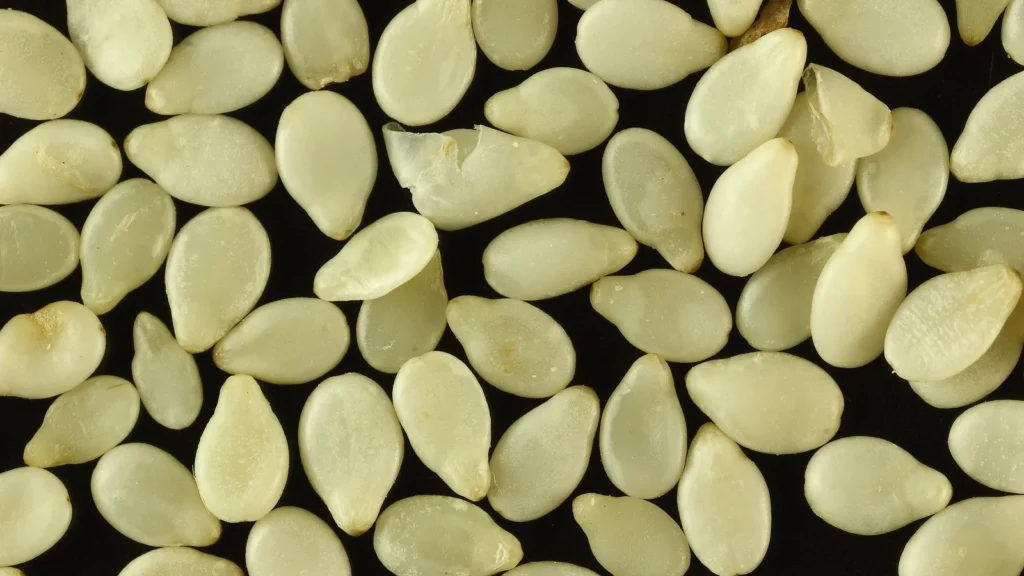

Sesame seeds are a staple of Greek cooking, from pasteli (sesame and honey bars) to tahini, sesame-crusted breads and koulourakia. This page sets out sesame seeds nutrition facts as published by USDA FoodData Central, the US government’s nutrient database. We report the numbers only; we don’t make health claims. If you have specific dietary needs, talk to a doctor or registered dietitian.

Sesame seeds nutrition per tablespoon
USDA lists one tablespoon of whole, dried sesame seeds as 9 g. Scaling the USDA per-100 g values to that portion gives approximately:
| Nutrient (1 tbsp, 9 g, whole dried) | Amount | % Daily Value* |
|---|---|---|
| Calories | 52 kcal | – |
| Total fat | 4.5 g | 6% |
| Protein | 1.6 g | – |
| Carbohydrate | 2.1 g | 1% |
| Dietary fibre | 1.1 g | 4% |
| Calcium | 88 mg | 7% |
| Iron | 1.3 mg | 7% |
| Magnesium | 32 mg | 8% |
| Copper | 0.37 mg | 41% |
| Zinc | 0.7 mg | 6% |
*Percentages are our calculation against the FDA Daily Values for adults (fat 78 g, carbohydrate 275 g, fibre 28 g, calcium 1,300 mg, iron 18 mg, magnesium 420 mg, copper 0.9 mg, zinc 11 mg), rounded.
Per 100 g: whole, hulled, toasted and tahini
Whether the seeds are hulled (decorticated) or toasted makes a real difference to some numbers, especially calcium. These are the USDA FoodData Central values per 100 g:
| Per 100 g | Whole, dried | Hulled kernels, dried | Whole, toasted | Tahini (toasted kernels) |
|---|---|---|---|---|
| Energy | 573 kcal | 631 kcal | 565 kcal | 595 kcal |
| Fat | 49.7 g | 61.2 g | 48.0 g | 53.8 g |
| Saturated fat | 7.0 g | 9.1 g | 6.7 g | 7.5 g |
| Monounsaturated fat | 18.8 g | 23.9 g | 18.1 g | 20.3 g |
| Polyunsaturated fat | 21.8 g | 25.5 g | 21.0 g | 23.6 g |
| Protein | 17.7 g | 20.5 g | 17.0 g | 17.0 g |
| Carbohydrate | 23.5 g | 11.7 g | 25.7 g | 21.2 g |
| Fibre | 11.8 g | 11.6 g | 14.0 g | 9.3 g |
| Calcium | 975 mg | 60 mg | 989 mg | 426 mg |
| Iron | 14.6 mg | 6.4 mg | 14.8 mg | 9.0 mg |
| Magnesium | 351 mg | 345 mg | 356 mg | 95 mg |
| Phosphorus | 629 mg | 667 mg | 638 mg | 732 mg |
| Zinc | 7.8 mg | 6.7 mg | 7.2 mg | 4.6 mg |
| Sodium | 11 mg | 47 mg | 11 mg | 115 mg |
Two things stand out. First, USDA’s calcium figure is far lower for hulled seeds: 975 mg per 100 g for whole seeds against 60 mg for hulled (decorticated) kernels. Tahini made from hulled kernels sits in between at 426 mg, according to its USDA entry. Second, sesame seeds are energy-dense, mostly from fat, so a portion is usually a spoonful rather than a handful.
Whole vs hulled sesame seeds
Whole (unhulled) sesame seeds keep their outer seed coat, so they are slightly darker, crunchier and a little more bitter. Hulled seeds are white, softer and milder, and are the usual choice for tahini and for many sweets. Black sesame seeds are a darker type, usually sold unhulled. Both whole and hulled seeds toast well; see how to toast sesame seeds.
How the numbers are measured
All figures come from USDA’s SR Legacy data set in FoodData Central, which reports average values for a food per 100 g. Real seeds vary with the crop, variety and processing, so the Nutrition Facts label on a specific packet may differ. Toasting removes a little water, which is why toasted values per 100 g are close to, but not the same as, dried values. Tahini values are for the most common type, made from roasted and toasted kernels.
Sesame in Greek food
- Pasteli: sesame seeds bound with honey into a crisp bar. Read what is pasteli? or try our pasteli sesame bar.
- Tahini: a sesame paste used in dips, dressings and Lenten cakes.
- Breads and biscuits: sesame-coated koulouri rings and koulourakia.
- As a seasoning: toasted seeds in za’atar or over a salad.
Sesame is a major allergen
Sesame can cause serious allergic reactions. In the United States it became the ninth major food allergen under the FASTER Act, and the FDA requires it to be declared on food labels from 1 January 2023. If you are cooking for others, tell them when a dish contains sesame or tahini.
Find more pantry nutrition guides, including dried figs nutrition and honey nutrition facts, in our Greek pantry guides, and browse the pasteli collection.
Sources
- USDA FoodData Central: Seeds, sesame seeds, whole, dried (FDC ID 170150)
- USDA FoodData Central: Seeds, sesame seed kernels, dried (decorticated) (FDC ID 169412)
- USDA FoodData Central: Seeds, sesame seeds, whole, roasted and toasted (FDC ID 170151)
- USDA FoodData Central: Seeds, sesame butter, tahini, from roasted and toasted kernels (FDC ID 170189)
- US FDA: Daily Value on the Nutrition and Supplement Facts labels
- US FDA: Food allergies, what you need to know (the 9 major food allergens)
Sesame seeds nutrition: frequently asked questions
How many calories are in a tablespoon of sesame seeds?
About 52 kcal for a 9 g tablespoon of whole dried sesame seeds, based on USDA FoodData Central values.
Do hulled sesame seeds have less calcium?
Yes, according to USDA data: whole dried seeds list 975 mg calcium per 100 g, hulled (decorticated) kernels 60 mg.
How much protein is in sesame seeds?
USDA lists 17.7 g protein per 100 g of whole dried seeds, or about 1.6 g per tablespoon.
Is sesame an allergen?
Yes. Sesame is the ninth major food allergen in the US, and it must be declared on food labels there since 1 January 2023.

Good things from our land, ideas for your table.
Explore the pantry journal →